Herbs Return

Not many herbs love Shasta County summers... most of us living things just tolerate the heat and desiccation, to be frank. However, with the cooling nights, lower sun angle, and the RAIN we just got, today, the herbs are looking great, again. And SOOOO: our CSA members received bunches of thyme, oregano, mint, and a sage sprig in their shares this week.

What to do with fresh herbs?

  1. You can dry them, certainly: all of those in this week's share dry well, with the possible exception of mint, which is better used fresh. I find that the best way to do this is by laying them on top of a tea towel in a sheet pan for a week or so, turning, occasionally, until they're pretty dry and the leaves are easy to strip from the stems. I strip the leaves, and then leave them alone for another three days or so to finish drying, fluffing them occasionally so that none lose out on getting a dry as possible. Then I crush them (optional!) and fill a dry, clean spice jar. All ready for kitchen use!
  2. You can root them! probably not the sage, but the oregano, mint, and thyme will all root nicely if kept in a container of water for a month or so. They're ready to plant in your own garden, after that!
  3. You can make this AMAZING chermoula sauce that Pedro and I have been enjoying on meat, cucumbers and tomatoes, and sandwiches (mixed with mayo - YUM!). It is good on everything, and is forgiving if you don't have a particular ingredient (or if you add in others that you happen to have a lot of!). I also find it quite a good place to hide a bit of turmeric... we try to get a good amount each week in our normal diet, as it's so healthy, but the flavour doesn't always go with everything. This sauce is a great way to get it!

Enjoy this week's share!

- Elizabeth

A Perfect Pear

When we purchased the property that is now Oliview, it came with a LOT of trash that we didn't want, but it also came with previous owners' plantings. We've been lobbied, on a number of occasions, to remove some of the older stuff, and occasionally we do try cutting out an old (sour!) grapevine or an invasive plum tree or seven... but we LOVE our pear trees. They don't look like much: there are three of them in various stages of limb loss, and no matter our attempts at pruning, there's a pretty high dead:live material ratio in two of them, but they PRODUCE! I joked with Pedro's mother last week about it being the food crop on the farm that we do the least to, and it is the most productive! 

Pears are an interesting fruit: they ripen from the inside to the outside. Therefore, it is tricky to figure out when they're ripe! We've been picking one/week for a while, now, and leaving them in paper bags for a week to see if the off gassing of ethylene gas (a natural off gassing of a number of fruits that encourages ripening) will allow them to ripen to an edible consistency. Off the tree they're rocks, you see. The flavor is great, but the texture is hard, hard, hard. Waiting just a week or two allows the pears to ripen, soften, and get this mellow, honey-pear scent that is just divine.

We leave pears at the tippy top of the tree, as well as those the birds have already gotten to (grumble!), because they look so beautiful AND because it's a lovely way to attract a diversity of birds to the yard when there's not a lot of other thing…

We leave pears at the tippy top of the tree, as well as those the birds have already gotten to (grumble!), because they look so beautiful AND because it's a lovely way to attract a diversity of birds to the yard when there's not a lot of other things to eat.

The bees like them, too, as do the birds. And both species are much, much better at sensing ripeness than we are! When we start seeing bees around the tree, and pears are getting little bee-mouth holes dug out of them - not dismissible, as they can finish off an entire pear! - then we know that they're ready, for sure, and we need to get out there and get picking!

One of the toughest-looking trees: it has survived at least one round of fire blight that we know of (in our five years here), and I'm sure there have been previous years with similar challenges. I use a 10-foot ladder, since it's not as scary at th…

One of the toughest-looking trees: it has survived at least one round of fire blight that we know of (in our five years here), and I'm sure there have been previous years with similar challenges. I use a 10-foot ladder, since it's not as scary at the top as some of those 16-footers!

Pears, pears, pears! I am a sucker for seasonal harbingers, and what more can you do to say that autumn is coming that pick a tub of pears?

Pears, pears, pears! I am a sucker for seasonal harbingers, and what more can you do to say that autumn is coming that pick a tub of pears?

Summer update (Really? It's still summer?)

As my title indicates, we can't believe that it is the end of August and we're still over 100 degrees. The nights are cool, though, so we take solace in that! It does make me think about the projected effects of climate change, and the general consensus of the effect of climate change on nighttime temperatures: moving them higher, and making it such that we don't have as much of a break from the daytime heat. Ugh. 

I've been doing some reading, lately, about rural parts of the nation - and the world - and how our communities' response to it will be different from those in urban communities. What I come across time and time again is concern and consideration for third-world agriculture (yes, it seems that ONLY agriculture is associated with rural economies... meh. Topic for another day.), but a dismissal of US-based agriculture and, thus, rural economies. The general consensus, it seems, from people who study these things professionally (and, I would venture, most often do NOT live in a rural setting!), is that the rural United States will adapt with government subsidies, national price supports, and a slow move of production economies to other parts of the country. It seems that the plan is to simply abandon those economies - and thus those communities - that get too hot, too dry, and otherwise unsuitable for growing food. This is an economic question, certainly, but it is also a socio-cultural question: are we so happy with our current system that we are actually planning to continue to move billions of pounds of food across thousands of miles to get it to the final consumer? Are we satisfied that the answer is to dissolve locally-developed cultures and socio-economic structures in the human equivalent of a mass-market, homogeneous, quantity-first Costco? Is there not a more adaptive, efficient, respectful, and sustainable system available to us? I think the answer is "yes", but acknowledge that it will require a wholesale re-think of our current food economy and the policies that support it, as well as our rural cultures and how they adapt to a changing climate - social and geophysical!

In the meantime, however - and on a lighter note! - some farm inhabitants aren't minding the heat... and are even thriving!

We found this little lady last week, under a brown-eyed susan, with four new babies:

Our newest brood of surprise chicks: it looks as though they posed! The three you can see, here, are Mottled Java chicks, and the fourth one is hiding behind the feeder, and is an Ameraucana.

Our newest brood of surprise chicks: it looks as though they posed! The three you can see, here, are Mottled Java chicks, and the fourth one is hiding behind the feeder, and is an Ameraucana.

And this bed of winter squash didn't get the memo that it's supposed to be a single bed: it's taking over at least two others, and working on the flower bed over the fence!

Three types of winter squash that seem to be loving this heat!

Three types of winter squash that seem to be loving this heat!

And, of course, our beloved summer queens, who just can't help but make you feel good when you look at them!

SummerSunflowers.jpg

All the same, we hope it's over, soon. It's this time of year that I start craving woven wool pants, slow-cooked meat stews, and apple everything. Enjoy these last few weeks of summer!

Summer is officially here!

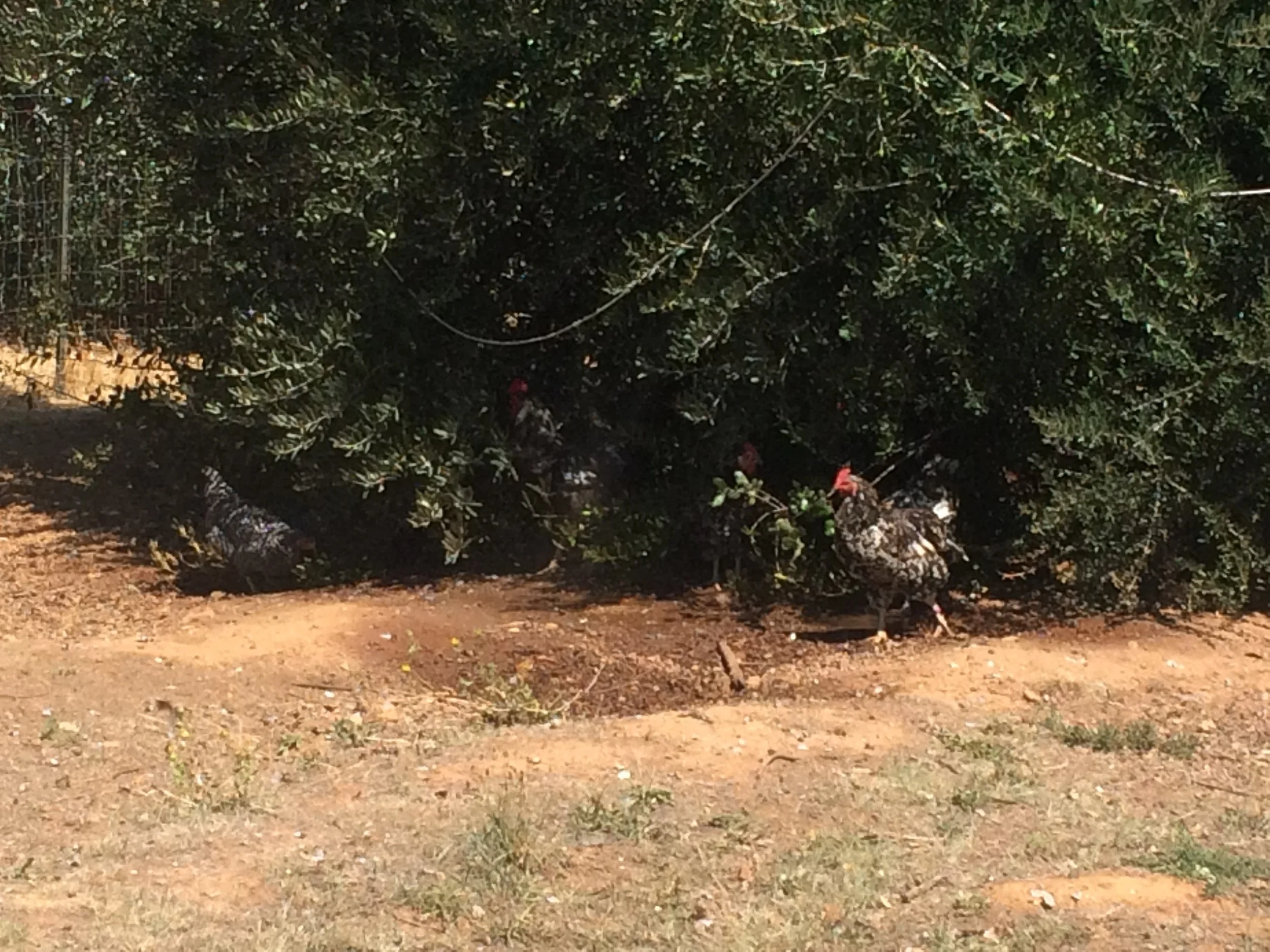
Okay, okay, so that calendar says that summer starts next week, but meteorologially-speaking, and based on actual in-the-dirt experience (when it actually feels like summer on the farm and which coincides with what indigenous cultures consider seasonal starts) summer started in the first week of May (45 days before the summer solstice)... and we've reached the first week-plus of 100-degree-plus weather. Whew. We're never ready for this, and always worry about the animals being ready for it. We make sure that they have plenty of shade, and both chickens and sheep get misters to create a micro climate of cool for them. We make sure that the soil under our porch is moist so that our cats and dog have a cool, shaded place to lay. But even with all of these things, we still worry, and try not to leave the farm without a human presence during the hottest times of the hottest days. As always, humans are essential components of our little farm ecosystem.


Chickens enjoying their mister!

Chickens enjoying their mister!

2017 Season is Here!

We are so pleased to release the 2017 Season!!! Changes include a lower price (reflecting fewer eggs available this year, while we expand our flock) and a new delivery day (yay, Monday afternoon/evening!). We hope that you'll find these changes productive and helpful.

As part of our CSA, we ask that members sign up through a very basic memorandum of agreement spelling out delivery days/times, expectations of quantity and quality, and other important characteristics that help everyone to be on the same page. I'll be looking to add this document in the near future. For now, if you're interested in the CSA, please contact us for more information and for the informational and sign-up documents.

We look forward to seeing you on the farm!